The browser you are using is not supported. Please consider using a modern browser.
U.S. Refugee Admissions Program
Understanding our call to welcome
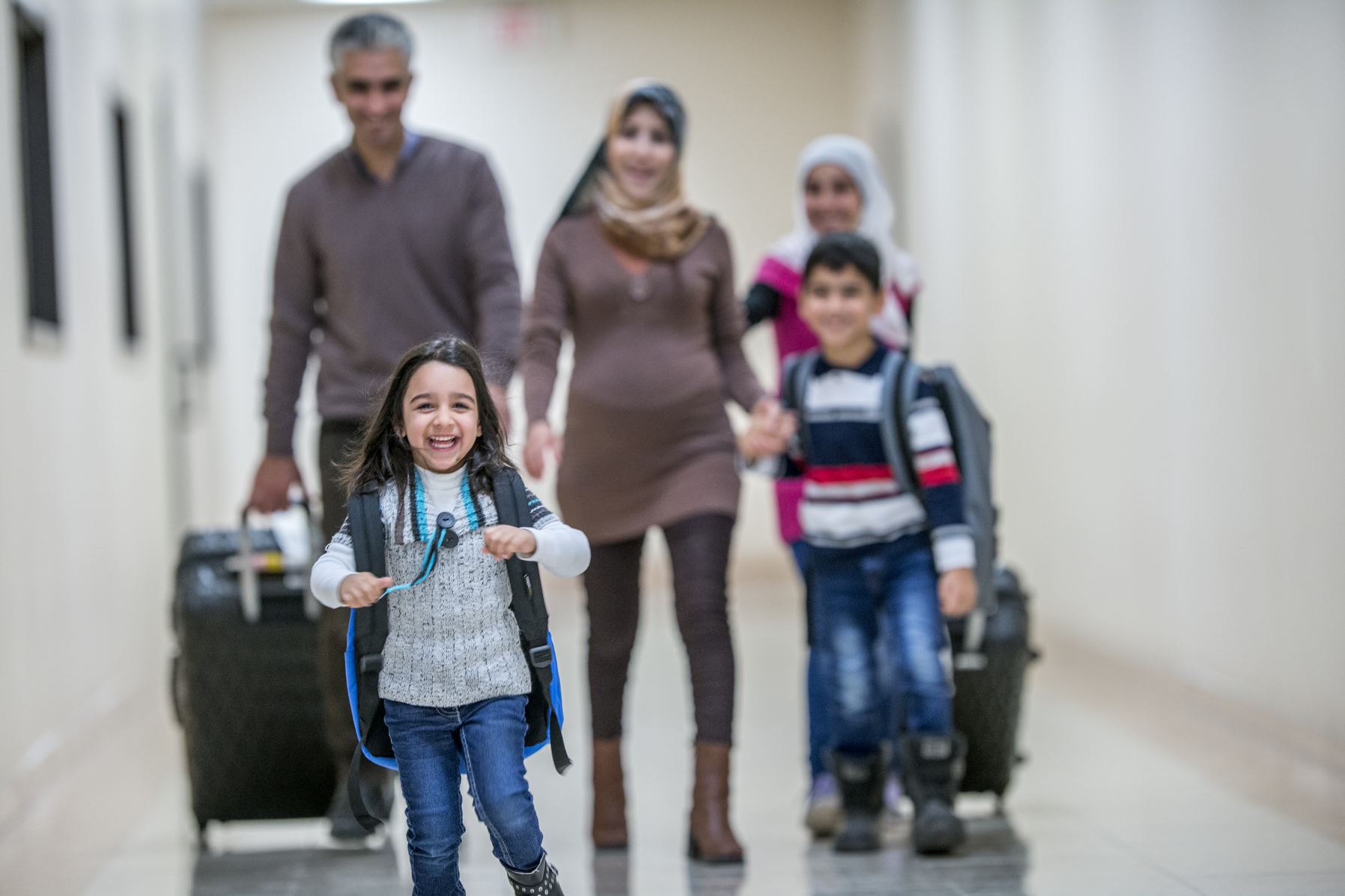
Global Refuge is committed to welcoming refugees into communities across the United States.
Our Long Welcome starts with a needs-based and inclusive Presidential Determination (PD) on refugee admissions, is facilitated by strong Congressional support and funding for refugee resettlement programming, and is shaped by support at the state, local, and community levels.
The Global Refuge Refugee Resettlement Information Page offers resources on the U.S. Resettlement Program, updates on refugee-related policy and legislation, and upcoming Global Refuge events and initiatives.
Background
The U.S. Refugee Admissions Program (USRAP) was created by Congress through the Refugee Act of 1980. This formal program identifies people who meet the legal definition of a refugee under U.S. law—someone outside their home country with a well‑founded fear of persecution based on race, religion, nationality, political opinion, or membership in a particular social group.
Refugees are interviewed and undergo some of the most rigorous security vetting of any entrant to the United States overseas, before they resettled in local communities, and are connected to services aimed at building rapid self-sufficiency and community integration.
The program has long enjoyed bipartisan support for offering refuge to populations that are a high humanitarian priority to the United States, while also supporting America’s workforce development and cultural vibrance.
Key Points
- Refugees are vetted overseas through extensive security checks and in‑person interviews with trained USCIS officers.
- Only after approval can they travel to the U.S., where local communities and nonprofits provide initial support like English classes, job training, and housing assistance.
- USRAP is not the same as seeking asylum at the border; it is a structured, overseas process.
The Presidential Determination (PD)
Every fiscal year, the President must set the refugee admissions ceiling—the maximum number of refugees who can be admitted to the United States under the U.S. Refugee Admissions Program. This number is called the Presidential Determination (PD).
How the PD Process Works
- Federal agencies review global refugee needs and U.S. capacity.
- The administration consults with Congress, as required by law.
- The President signs the Presidential Determination, which sets:
- The total number of refugees who may be admitted
- Regional allocations (how many slots go to different parts of the world)
- No refugees can be admitted in a new fiscal year until the PD is signed.
The PD is a ceiling, not a guarantee—the government may admit fewer refugees depending on processing capacity, policy choices, or global events.
Refugee Resettlement FAQ
-
The United Nations High Commissioner for Refugees (UNHCR) estimates there are more than 117.8 million forcibly displaced across the globe. While a majority of people are internally displaced, 41.6 million are refugees and individuals who have been forced to flee their countries and seek refuge elsewhere. The total displaced population of 117.8 million is similar to the population of the Philippines, the 13th most-populated country in the world.
-
69 percent of all refugees are from five countries: Syria, Sudan, Ukraine, Afghanistan, and South Sudan. 69 percent of refugees are hosted by their neighboring countries. Countries hosting the largest number of refugees are Türkiye, Chad, Germany, Bangladesh, and Uganda.
Millions of refugees live in refugee camps or settlements, whereas others are integrated into their host countries. On average, refugees who remain in camps are more likely to live below the national extreme poverty line, although finding safe housing and employment outside the camp is also very challenging.
-
Millions of refugees around the globe face persecution due to race, ethnicity, religion, nationality, gender, and political and social group affiliations. International displacement is driven by a confluence of factors, including inter- and intra- state conflict, political instability, and, increasingly, climate disasters.
Often, there is overlap between some of these factors. However, to qualify for refugee status according to the 1951 Refugee Convention and its 1967 Protocol, a refugee is an individual who “is unable or unwilling to return to their country of origin owing to a well-founded fear of being persecuted for reasons of race, religion, nationality, membership of a particular social group, or political opinion.”
This refugee status definition is foundational to the definitions of refugees codified into national laws across the globe, including the U.S Refugee Act of 1980.
Nations who signed these international laws, including the U.S., are also subject to abiding by the prohibition on refoulement, meaning they cannot return persons to their home countries if their lives are threatened or persecuted for the reasons mentioned in the refugee status definition.
-
Since early 2025, the U.S. Refugee Admissions Program (USRAP) has been largely shut down. President Trump issued Executive Order 14163 declaring that refugee admissions were “detrimental to the interests of the United States” and suspended the program, allowing only rare, case‑by‑case exceptions.
In practice, this means that refugee resettlement is not operating normally. Only a small number of refugees—those who meet narrow “national interest” exceptions—are being admitted. Tens of thousands of refugees already approved or in the pipeline have been left in limbo.
-
Rooted in faith, Global Refuge believes that we are called to welcome those fleeing persecution and seeking refuge in the United States. Resettlement is a life-saving program for the most vulnerable and a practice in devotion for many in receiving communities. Across the U.S., faith communities remain ready and eager to welcome refugees.
Global Refuge works to welcome refugees into communities that best suit the needs of the refugees. Global Refuge and network partners operate resettlement and placement sites across the United States – making it one of the largest resettlement agencies in the United States. The Global Refuge network receives government funding that supports our work of welcome through robust case management services for newcomers as they work to integrate into their new communities.
-
Yes. All refugees must undergo a stringent series of screenings, USCIS interviews, security vetting, and medical checks prior to their arrival in the U.S.
After the screening and vetting process has concluded, refugees are then connected with one of the national resettlement agencies across the United States that welcome the refugees into communities, help them secure housing, find employment, support language learning services, and support their overall integration into their new communities.
-
While faith groups had long welcomed those forced to flee, the U.S. refugee admissions program was formally established by Congress through the Refugee Act of 1980. The Refugee Act amended other immigration laws and created an annual admission limit, which could be set by the President based on the global humanitarian situation warranting the resettlement of more refugees in the United States.
The Refugee Act requires that the President annually consults with Congress to assess the scope of global humanitarian disaster, sets a U.S. admissions goal based on global needs and congressional funding, and provides a pipeline for internationally displaced populations to lawfully enter the U.S. after extensive security screening and vetting processes. After this assessment and consultation process, the President sets an annual determination, or goal, on refugee admissions for that particular year. The annual determination is often called the “PD.”
Over the last fiscal year, the Presidential Determination—normally a tool for setting broad, humanitarian admissions goals—has been used in a highly restrictive and politicized way.
The FY2026 refugee ceiling/PD was set at 17,500, the lowest in USRAP’s history. Actual admissions have been even lower. Admissions are primarily allocated to one group from South Africa, under Executive Order 14204. All admissions remain subject to multiple restrictive executive orders, including:
EO 14161: Mandates the most stringent ID verification of any immigrant category. EO 14163: Suspends refugee entry except for rare national‑interest exceptions. Proclamation 10949: Bars entry of certain foreign nationals deemed “detrimental.”
This is a fundamental departure from decades of bipartisan refugee policy that prioritized global humanitarian need.
-
USRAP is designed to respond to global displacement needs, not to prioritize a single nationality. Under a functioning program, the U.S. typically resettles refugees from:
Sub‑Saharan Africa Democratic Republic of Congo Somalia Ethiopia Sudan/South Sudan Near East and South Asia Afghans (including P‑1 referrals, P‑2 groups, family reunification, and SIV‑linked cases) Tens of thousands of Afghans remain in the USRAP pipeline. Syrians Iraqis (including P‑2 Direct Access cases) These groups face ongoing conflict, targeted violence, and persecution. East Asia Burmese (including Rohingya and other ethnic minorities fleeing genocide and persecution) Latin America and the Caribbean Venezuelans Colombians Cubans
Family Reunification Cases
USRAP normally includes Priority 3 (P‑3) “follow‑to‑join” cases—allowing refugees already resettled in the U.S. to reunite with spouses, parents, and children.
Special Humanitarian Programs: A functioning USRAP also resettles refugees through designated programs such as:
Lautenberg Amendment (religious minorities from Iran and the former Soviet Union)Iraqi P‑2 Direct Access Program (for Iraqis affiliated with the U.S. mission) Afghan P‑1 and P‑2 referrals (including those with U.S. ties)
These programs reflect decades of bipartisan commitments to vulnerable groups.
What the PD Normally Looks Like
Under a typical Presidential Determination, the U.S. sets regional allocations based on global need. For example, in FY2025 (before the suspension), the PD allocated:
Africa: 30,000–50,000 Near East/South Asia: 30,000–45,000 Latin America/Caribbean: 35,000–50,000 East Asia: 10,000–20,000 Europe/Central Asia: 2,000–3,000
These ranges reflect the populations the U.S. should be resettling when USRAP is fully functioning.
-
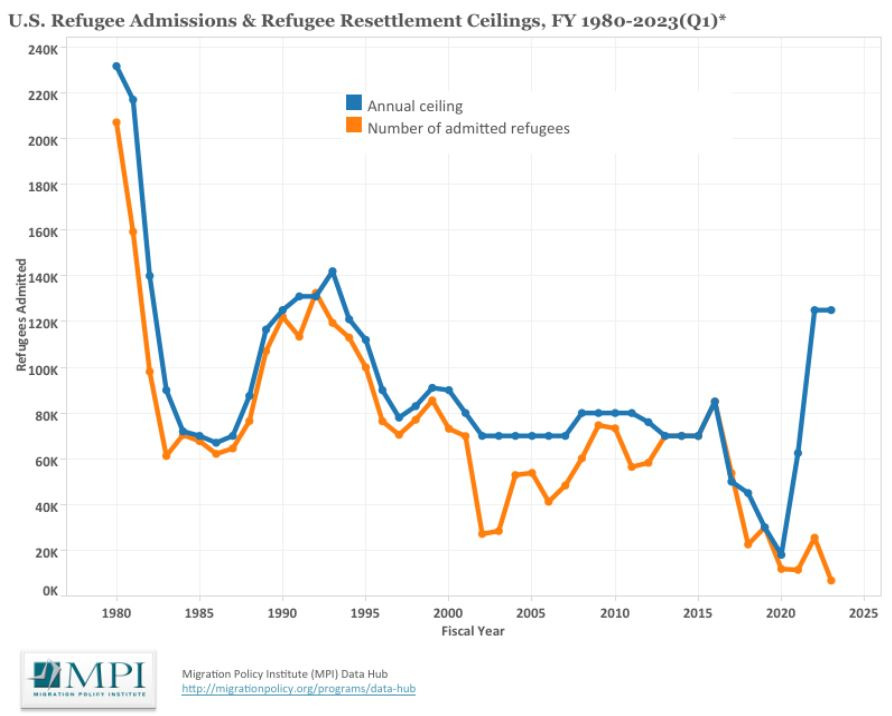
The actual number of refugees welcomed to the United States has varied based upon a variety of factors, including the respective administration’s prioritization of the refugee program, the annual Presidential Determination, and Congressional appropriations. See the Migration Policy Institute’s graph below comparing the PD on resettlement admissions to the number of refugees admitted to the U.S. between 1980 and 2024.
-
Refugees play a vital role in strengthening America’s workforce and economy. They arrive legally, fully vetted, and ready to work, stepping directly into industries facing severe labor shortages and helping employers stay open. Across the country, refugees contribute billions to the U.S. economy, generating a net fiscal gain of more than $120 billion between 2005 and 2019. They are overwhelmingly of working age — 77.7%, compared to 61.3% of U.S.-born residents — which means they help sustain Social Security and Medicare at a time when America’s population is aging. Refugees also start businesses at high rates, generating billions in annual revenue, revitalizing main streets, and creating jobs in communities that need them. Economists warn that scaling back legal immigration pathways, including refugee admissions, would reduce economic growth by nearly $900 billion between 2025 and 2028.
Beyond economics, refugees strengthen civic life: they shop locally, volunteer in schools and churches, and contribute to the social fabric that keeps communities strong. In every measurable way — workforce, entrepreneurship, fiscal impact, and community vitality — refugees help America thrive.
Our Work in Action
Hear the stories of former refugees in their own words. Share on your social networks to bring more attention and support to the refugee journey in the United States.



You can change lives.
Explore the many ways to support Global Refuge.
Get InvolvedExplore the many ways to support Global Refuge.
Get Involved