When Global Refuge launched our Faith Alliance Safe Welcome Training, our goal was to help communities of faith take concrete steps to safely welcome their immigrant neighbors. The training guides congregations through four modules focused on highlighting immigration in Scripture, learning immigration fundamentals, uplifting immigrant voices, and learning about safe welcome practices from other congregations.
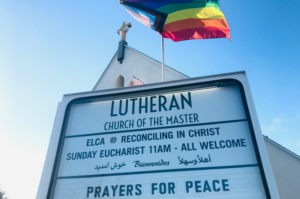 For Pastor Peg S. and Lutheran Church of the Master in Los Angeles, the training came at exactly the right time. While the congregation had been welcoming immigrant neighbors for years, they were looking for a more structured way to focus their efforts.
“We wanted a way to organize but didn’t know where to begin,” Pastor Peg recalled. “And then Faith Alliance came along and helped us do that.”
Located near UCLA in the Westwood neighborhood of Los Angeles, the congregation sits in one of the city’s most diverse communities. Often referred to as “Little Tehran,” the area is home to many Persian restaurants and business and attracts visitors from Iran, Lebanon, Palestine, and countries around the world.
Welcoming newcomers has been central to Pastor Peg’s faith for decades.
“I’ve been connected with Global Refuge since I’ve been a pastor for 40-plus years,” she said. “We’ve been grateful for the partnership and for all the work Global Refuge does to support immigrants who are facing such extreme challenges right now.”
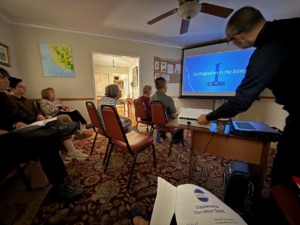
She said her commitment to welcome is based on the Gospel itself.
“If we read the Bible and know Jesus at all, this is who Jesus was,” she said. “Jesus welcomed everybody and was concerned for those who had the greatest needs.”
Pastor Peg often speaks about what she calls a Lutheran understanding of “neighborology.”
“We are neighbors with everyone,” she said. “Not just those who live next door to us, but neighbors across all walks.”
That belief shaped how the congregation approached the Faith Alliance training. Church members saw the training as an opportunity to strengthen and formalize the welcome they were already offering.
One of the things Pastor Peg said she appreciated most was the program’s emphasis on action, encouraging congregations to identify three specific actions they could realistically focus on.
The congregation’s first action item grew from conversations with immigrants in their community. Church leaders learned that many people feared not knowing who would advocate for them—or even be notified—if they were detained.
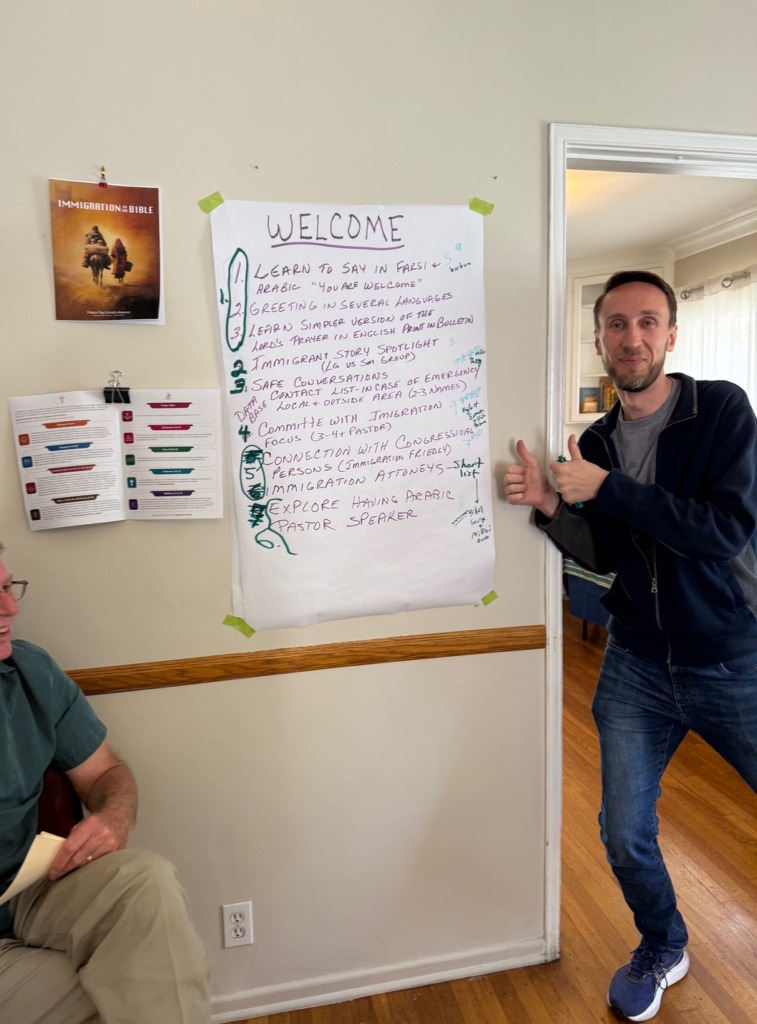
In response, the church began creating systems and contact networks so that families, attorneys, and church leaders can communicate more easily during moments of crisis.
For their second action item, they established an official Immigrant Welcome and Outreach Committee and voted to make it part of the church’s organizational structure.
The third action item centered on belonging. Church members are learning how to welcome immigrant neighbors in their own languages. The congregation created resources, including bookmarks, that include the Lord’s Prayer in English and Farsi and has begun teaching members simple phrases they can use when newcomers arrive.
“We want the entire congregation to learn how to say, ‘Welcome’ and ‘God loves you’ in Farsi,” Pastor Peg said. “So when someone new comes, anyone sitting in the pew can turn around and let them know they belong here.”
As immigration challenges continue to affect families throughout the country, Pastor Peg believes the faith community has an important role to play.
“It takes work to get to know your neighbor,” she said. “But welcome is always worth it.”